
Treatments for erection problems
Page summary
Treatments for erection problems include tablets, vacuum pumps, injections, pellets, creams, implants and testosterone replacement therapy.
There are also lifestyle changes that may help with improving your erectile function after prostate cancer treatment.
How well each treatment works varies from person to person and depends on different factors such as your overall health and your ability to get erections before prostate cancer treatment.
It can take a while to notice an improvement in your erections and you may have to try different treatments to see what works for you. Some men might not be able to get an erection even with medical help.
Support from our Specialist Nurses
Our Specialist Nurses offer a sexual support service. This is a chance for you, or your partner, to talk to one of our Specialist Nurses trained in sexual problems after treatment for prostate cancer. They can talk to you about the impact of treatment on your sex life and relationships, and discuss possible treatments or ways to deal with these changes.
How well do treatments for erection problems work?
How well each treatment works varies from person to person. It depends on things like:
your overall health
your ability to get erections before your prostate cancer treatment
the other treatments for erection problems that you try
your age.
How long does erection recovery usually take?
It can take anything from a few months to a few years for erections to return, and they may not be as strong as before. Try different treatments and stick with them for a while to find the best option for you.
Some men will always need medical help to get an erection, and some might not be able to get an erection even with medical help.
As well as using the treatments for erection problems, there are lifestyle changes you can make too – like quitting smoking.
How do my thoughts and feelings affect my erectile function?
Getting an erection relies on your thoughts and feelings. So, tackling any worries or relationship issues you may have, as well as having medical treatment, can work well.
There are lots of ways to get support, including:
talking to someone close to you
speaking to your nurse or doctor
getting some counselling or sex therapy.
Will the treatments work if I'm on hormone therapy?
Hormone therapy lowers your desire for sex. This may mean that treatments such as tablets don’t work as well for you, because they work best when you have desire. But they are still worth trying. If tablets don’t help, injections, pellets, cream or vacuum pump may give you an erection.
Even if you don’t have a strong desire for sex, having regular erections can help keep your penis healthy and may prevent it from getting shorter. This is because erections encourage blood flow to the penis, so the cells get a good supply of oxygen.
Stick with your treatment
Treatments for erection problems aren’t always a ‘quick fix’. You often have to stick with them for a while, or try different treatments to see what works best for you.
Men who try more treatments for erection problems are more likely to find one that works. A combination of treatments, such as tablets and a vacuum pump, may work better than one treatment on its own.
If you’ve had surgery, your erections may improve over time as your nerves recover. So, if the treatments don’t work at first, it’s worth trying them again in a few months.
How do I fit the treatment into my sex life?
Some treatments for erection problems can seem artificial, and you may feel like you lose the moment. But people often find they get used to them. Some couples use their treatment as part of foreplay, such as using the vacuum pump or rubbing in the cream together.
Your partner can go with you to your appointments, as it may help for them to know how the treatments work too. You might be able to try your new treatment with your partner in the room.
What if I have other health problems?
Some treatments for erection problems may not be suitable if:
you have a heart problem
you have sickle cell disease
you have Peyronie’s disease (where the penis is curved)
you’re taking medicines called nitrates.
Ask your doctor or nurse for advice if you have any of these health problems, and let them know about any medicines you’re taking. You’ll also find more information about this in the leaflet that comes with your treatment.
How do you keep your penis active after surgery?
Although you may not be ready or recovered enough for sex, you can still start treatment for erection problems in the weeks immediately after surgery. It could be taking a low-dose tablet once a day or using a vacuum pump, or both together. The treatment, along with masturbation, helps blood flow to the penis. This can help keep your penis healthy because it means the cells have a good supply of oxygen. You may hear this called penile rehabilitation.
Think of it in the same way as having physiotherapy if you had injured an arm or leg. Starting treatment soon after surgery may improve your chance of getting and keeping an erection later on. Ask your doctor or nurse about when is best to start penile rehabilitation.
Phosphodiesterase type 5 (PDE5) inhibitors tablets
A group of drugs called PDE5 inhibitors can help you get an erection after prostate cancer treatment.
These include:
sildenafil (generic sildenafil or Viagra®)
tadalafil (generic tadalafil or Cialis®)
vardenafil (generic vardenafil or Levitra®)
avanafil (Spedra®).
How well do PDE5 inhibitor tablets work?
How well these drugs work varies from man to man. The tablets are quick and easy to take, and don’t interfere with foreplay. It’s good to start taking them soon after prostate cancer treatment, as you may get your erections back sooner.
There hasn’t been any research comparing how well the different types of PDE5 inhibitors work in men who have had prostate cancer treatment, so we can’t say if one drug is better than another.
How do PDE5 inhibitor tablets work?
You need to be sexually aroused for the tablets to work. If you have a low sex drive or low testosterone level – for example, if you’re on hormone therapy – they might not work so well for you but they are still worth trying.
The tablets normally start to work about 30 minutes to an hour after taking them. Make sure you allow enough time for them to work, otherwise it might seem like they’re not working when they are.
You can take sildenafil, avanafil and vardenafil when you need to. They will keep working for four to six hours, or up to eight hours for vardenafil. If they work for you, you should be able to get an erection if you’re sexually aroused during that time.
You can take tadalafil when you need to. It can work for up to 36 hours, so you can be more spontaneous about when you have sex or masturbate. Or your doctor may suggest taking a low-dose (5mg) tadalafil tablet every day.
If you have a choice of drug, think about which one fits in best with your sex life. Your doctor will help you find the one that might work best for your situation. The dose you have will vary. Some men start with a low dose, but you can go up to a higher dose if it isn’t working. If the maximum dose of one type of drug doesn’t work, another drug may work better for you.
Watch our video on how to use tablets to get an erection.
PDE5 inhibitor tablets take time to work - don't give up
PDE5 inhibitors may not work the first few times you try them. It can take a while to get the timing right. Try each type of drug at least eight times before changing to a different one. While you’re waiting for the tablets to work, try another treatment at the same time – such as a vacuum pump – to help keep your penis active and healthy.
You may need to take your tablet on an empty stomach, as it may not work as well after a big or fatty meal, or with alcohol or grapefruit juice. Read the leaflet that comes with your tablets, or ask your doctor, nurse or a pharmacist if you’re not sure.
If you’ve had surgery, and your surgeon was able to save the erectile nerves that help you get erections (nerve-sparing surgery), you’ll be offered PDE5 inhibitors. But even with nerve-sparing surgery, it can take months or even years for the nerves to fully recover, so it may feel like a long time before the tablets start working.
If your surgeon wasn’t able to save the nerves, your doctor might still suggest you try PDE5 inhibitors, as they can still sometimes have an effect. But the other treatment options may be more effective, including the vacuum pump.
What are the side effects of PDE5 inhibitors tablets?
PDE5 inhibitors are generally safe, but they can cause side effects. These are usually mild and don’t last long. They include:
headaches
indigestion
a flushed face
itchiness or swelling in your nose (rhinitis)
muscle pain
back pain
leg pain.
Interactions with other medicines
PDE5 inhibitor tablets might not work well for everyone, including some people who take certain medications:
PDE5 inhibitor tablets can cause a drop in your blood pressure. This doesn’t cause problems for most men, but tell your doctor or nurse if you’re taking medicine to control your blood pressure. For example, if you’re taking alpha blockers, you may need to take the drugs at least four hours apart from each other.
You shouldn’t take PDE5 inhibitor tablets if you’re taking drugs called nitrates. Taking these treatments at the same time can cause your blood pressure to drop dangerously low, which can be fatal. Nitrates are usually used to treat heart problems. They are also used in recreational drugs known as poppers. If you have a heart problem or take nitrates, ask your doctor or specialist about other ways to treat your erection problems.
You may be offered a smaller dose if you’re already taking medication for HIV (antiretroviral drugs). This is because HIV drugs can react with some other medicines. This can cause side effects that may be serious.
Don’t use PDE5 inhibitor tablets and injections together because this increases the risk of priapism (where your erection doesn’t go down).
Always check with your doctor or nurse if you’re not sure whether tablets are right for you.
Buying tablets on the internet can be dangerous. This is because:
they might be fake
you won’t know the right dose for you
they could contain harmful ingredients
they could interact with other drugs.
Only use medicines that have been prescribed by a health professional, or that you have purchased from a pharmacy. Some types of sildenafil and tadalafil are available from a pharmacy after a discussion with a pharmacist.
If you do order medicine online, make sure it’s from a well-known pharmacy that you trust. If your GP can’t prescribe tablets, then ask to be referred to an ED clinic.
Herbal medicines for erection problems, like ‘herbal Viagra’ which is sold in Chinese herbal medicine stores, can also be unsafe. Not all herbal remedies sold in the UK are licensed, and the quality varies a lot.
Also, be very careful when buying herbal remedies over the internet. Many are made outside the UK and may not be high-quality. And many companies make claims that are not based on proper research. There may be no real evidence that their products work, and some may even be harmful.
Remember, even if a product is ‘natural’ that doesn’t mean it’s safe. Speak to your doctor before taking any herbal remedies. You can also find more information about an herbal medicine on the Medicines & Healthcare products Regulatory Agency website.
Vacuum pumps
Vacuum pumps can be used as a treatment for erection problems. They can help you to:
get an erection for sex or masturbation
keep your penis healthy in the long term and maintain the size of your penis.
How well do vacuum pumps work?
Using a vacuum pump can be an effective way to get an erection hard enough for penetration. Satisfaction with the pump varies, but men who have good results will often keep using it. A lot of men use the pump in combination with other treatments, such as tablets or injections.
The vacuum pump may also help maintain the length and thickness of your penis if used regularly and soon after surgery.
How do vacuum pumps work?
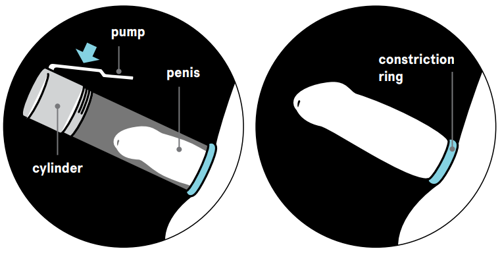
You can usually start to use the vacuum pump around four to six weeks after surgery and having your catheter removed). You put your penis into the cylinder and use the pump to draw the air out of the cylinder, creating a vacuum inside. This makes blood flow into your penis to make it hard. Your nurse or doctor will show you how it works.
Watch our video on how to safely use a vacuum pump to get an erection.
How to use the pump for sex or masturbation
After using the pump to get an erection, slip a constriction ring from the end of the cylinder around the base of your penis. This stops most of the blood escaping when you remove the pump. You shouldn’t wear the ring for longer than 30 minutes at a time.
Some men find that their penis moves around a bit because the base of their penis is still soft, making it difficult to have sex at first. You or your partner may need to guide the penis in. Shaving the hairs around the base of your penis can make it easier to use the pump.
Some men prefer the vacuum pump because you don’t need to use tablets or injections and you can use it as often as you like. With a little practice, the pump can help you get an erection in two to three minutes.
The way the vacuum pump works doesn’t involve the nerves that are usually needed for erections. So if your nerves were removed or affected during your prostate cancer treatment, the vacuum pump could be a good option for you.
How to use the pump to keep your penis healthy
To keep your penis healthy, you could use the pump every day. Use the pump to get an erection and hold the erection in the cylinder for 20 seconds. Then release the pressure and pump again to get another erection. Keep repeating this for no more than 10 minutes, as more than that could become uncomfortable.
Check the instructions that came with your pump, or speak to your doctor or nurse if you’re not sure how to use it safely.
Don’t use a constriction ring if you’re using the pump to keep your penis healthy – only use a ring when you want an erection for sex or masturbation. The ring reduces blood flow into your penis, and your penis needs oxygenated blood to stay healthy.
What are the side effects of vacuum pumps?
Vacuum pumps are safe to use and can be used alongside other treatments. But you might notice the following:
your penis might feel slightly cooler than usual
you might not be able to ejaculate while you’re using a constriction ring
it might feel painful or uncomfortable to use
you might experience some bruising or numbness.
Things to be aware of
The vacuum pump might not be suitable if:
you have a bleeding disorder
you take drugs to thin your blood
you have Peyronie's disease (where the penis is curved).
Speak to your doctor or nurse about whether the pump is suitable for you.
How do I buy a vacuum pump?
Vacuum pumps are usually available on the NHS. You can buy one yourself, but always ask your doctor, nurse or specialist for advice on choosing one that’s suitable.
Injections
Erection problems can be treated with drugs using an injection that you give yourself. These include:
alprostadil (Caverject®, Caverject® Dual Chamber, Viridal Duo®)
aviptadil with phentolamine mesilate (Invicorp®).
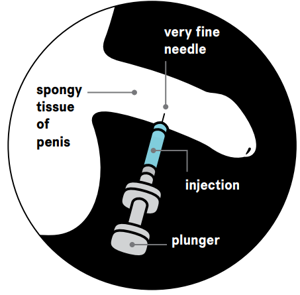
An injection may sound off-putting, but many men find it isn’t that bad and doesn’t hurt. Your nurse or doctor will show you how to inject the side of your penis with a very thin needle. They will make sure you’re happy giving yourself the injection before you go home.
How well do injections work?
Injections often work well. They work quickly because the drug goes straight to where it’s needed, and they give a natural-looking erection. It helps if you start them soon after your prostate cancer treatment.
Injections should work if you have little or no sexual desire (libido), but they work better when you have some sexual interest and stimulation. It might take a while before you find the right dose for you.
How do injections work?
The injection causes blood to flow into the penis, allowing it to become hard. You’ll get an erection quickly, within 5 to 10 minutes, and it lasts for up to an hour.
You need to be able to see your penis to use the injection. If you have sight problems, a big belly or a hidden penis, it may not be suitable for you. If you have any difficulties using your hands, it may also be harder to use the injection.
Watch our video on how to use injections to get an erection.
What are the side effects of injections?
Some men who use alprostadil find their penis hurts or aches for a few hours afterwards. If you use aviptadil with phentolamine mesilate, you may find that your penis becomes flushed or bruised, but it shouldn’t hurt. If you have any other side effects, tell your doctor or nurse.
Pellets or cream
The drug alprostadil, used in the injections described above, is also available as a small pellet and as a cream.
How well do pellets or cream work?
The pellets or cream don’t tend to work as well as the injections, but they’re a good alternative if you don’t like the idea of an injection. They can work if you have a low libido, but they work better when you have some sexual interest and stimulation.
How do the pellets or cream work?
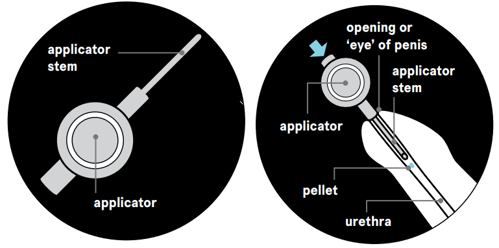
You use an applicator to insert the pellet or cream into the opening or ‘eye’ of the penis. The applicator can be difficult to use at first but it shouldn’t hurt.
With the pellet, it helps if your urethra (the tube you urinate through) is moist, so urinate first. Watch our video on how to use the pellet to get an erection.
With the cream, you or your partner can rub in any cream that’s left on the tip and massage your penis to help it absorb the drug. Watch our video on how to use the cream to get an erection.
If the pellet works you should get an erection very quickly – within five to 10 minutes – which lasts for up to an hour. The cream may take a little longer to work.
What are the side effects of the pellets or cream?
The pellets or cream can sometimes cause dizziness, or discomfort or pain in the penis or testicles.
The pellets and cream can also cause your partner to experience discomfort or pain after sex – but this is rare. If this does happen, you should use a condom during sex. You should also use a condom if your partner is pregnant.
With all treatments for erection problems, some men may find their erection won’t go down and this can be painful. If this happens, these activities might help:
having sex or masturbating
squatting
walking up and down the stairs
urinating (weeing)
placing something cold on the area (such as a bag of frozen peas).
Go to your nearest accident and emergency (A&E) department straight away if your erection lasts more than four hours. This is called priapism and is considered a medical emergency, but it can be treated.
Developing priapism is very rare – less than 1 in 100 men who use treatments for erection problems experience priapism. With injections, the figure is slightly higher – about 1 in 100 (one per cent).
Implants
This treatment for erection problems involves having an operation to put an implant inside your penis. Although it might sound off-putting, it can be a good option if other treatments haven’t worked.
How well do implants work?
Most men who have an implant are satisfied with it. It allows you to have an erection when you want one, and it doesn’t affect urinating, feeling or orgasm.
How do implants work?
There are two main types of implant:
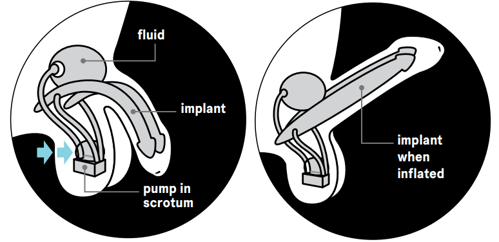
Semi-rigid rods that keep the penis fairly firm all the time, but allow it to be bent down when you don’t want an erection.
An inflatable implant in the penis and a pump in the scrotum (the skin around the testicles). When you squeeze the pump the implant fills with fluid (saline) to make the penis hard. The fluid is either contained in the pump in the scrotum, or in a separate container that sits in your lower abdomen, just above your penis. Your erection will last for as long as the implant is inflated and you can deflate it when you want to. This type of implant gives a more natural erection, although the tip of the penis may stay soft.
Watch our video on how to use an implant to get an erection.
What are the side effects of implants?
Implants are generally safe, but about 3 in 100 men (three per cent) who have an implant get an infection. If you got an infection, the implant would be taken out to treat the infection, and then a new one would be put in. You will be given antibiotics after surgery to help prevent this.
You may have some bruising and swelling around your scrotum after surgery. And you’ll feel some pain in your penis and around the cuts where your implants have been put in. You’ll be given some painkillers to help with the pain, and it should get better after a few weeks. It might help to wear supportive underwear and angle your penis upwards.
The inflatable implant usually lasts around 10 to 15 years. But around 5 in 100 men (five per cent) may need to have it replaced within ten years. The semi-rigid implant is less likely to need replacing.
Testosterone replacement therapy
Testosterone is a hormone that controls the growth of the male sex organs, including the prostate. It also affects other male characteristics, such as erections and muscle strength. Most of the testosterone in your body is made by the testicles.
Different things can affect your testosterone levels, including several health problems. If you have very low testosterone, you may have erection problems or a low libido. If your erection problems are caused by low testosterone, such as after hormone therapy, then you may be able to have testosterone replacement therapy. It works by increasing the levels of testosterone in your body to a normal level. This may improve your orgasms, ejaculation and erections. It may also make some treatments for erection problems (including PDE5 inhibitor tablets) work better.
If your doctor or nurse suggests trying testosterone replacement therapy, ask them about the risks and benefits. For example, testosterone can make prostate cancer cells grow faster, so it isn’t usually recommended if you still have prostate cancer. And you won’t be able to have it if you’re having hormone therapy.
Some research has shown that testosterone replacement therapy is safe for men who’ve been successfully treated for localised prostate cancer, where all of their cancer has been removed or destroyed. Your doctor will be able to explain more about whether this is safe for you.
If you decide to have testosterone therapy, it’s important to see the doctor or medical team who treated your prostate cancer, rather than go to a different doctor. And if you have it, you will need to have regular prostate specific antigen (PSA) blood tests to check for any signs of your cancer returning. If there are any changes in your PSA level, you will be sent for further tests, such as a PET (positron emission tomography) scan.
What lifestyle changes can help with erection problems?
Staying a healthy weight through a balanced diet and physical activity can help improve your sex life. It can also lower the risk of some health problems that can cause erection problems, such as type-2 diabetes.
Physical activity can also improve your energy levels, lift your mood and help with some of the side effects of treatment, such as fatigue.
Some men find that pelvic floor muscle exercises help improve the quality of their erections.
Smoking may increase your risk of erection problems, and affect how well treatments for erection problems work. Stopping smoking isn’t easy, but help is available. The NHS website has information, advice and support for giving up smoking.
References and reviewers
Updated: March 2026 | Due for Review: March 2029
Bassil N, Alkaade S, Morley JE. The benefits and risks of testosterone replacement therapy: a review. Ther Clin Risk Manag. 2009;5:427–48. PubMed PMID: 19707253; PubMed Central PMCID: PMC2701485
Bock M, Burns RT, Pereira TA, Bernie HL. A contemporary review of the treatments and challenges associated with penile rehabilitation after radical prostatectomy including a proposed optimal approach. Int J Impot Res. 2024;36:480–5.
British Association of Urological Surgeons (BAUS). Penile prostheses.pdf [Internet]. 2024 [cited 2025 Nov 7]. Available from: https://www.baus.org.uk/_userfiles/pages/files/Patients/Leaflets/Penile%20prostheses.pdf
Caverject 5 micrograms powder for solution for injection: Summary of Product Characteristics [Internet]. 2013. Available from: https://www.medicines.org.uk/emc/medicine/1480
Clavell-Hernandez J, Wang R. Penile rehabilitation following prostate cancer treatment: review of current literature. Asian J Androl. 2015;17:916.
Cormie P, Zopf EM. Exercise medicine for the management of androgen deprivation therapyrelated side effects in prostate cancer. Urol Oncol Semin Orig Investig. 2020;62–70.
Cornford P, Tilki D, van der Bergh RCN, Eberli D, De Meerleer G, De Santis M, et al. EAU - EANM - ESTRO - ESUR - ISUP - SIOG Guidelines on Prostate Cancer. European Association of Urology; 2025.
Doherty W, Bridge P. A Systematic Review of the Role of Penile Rehabilitation in Prostate Cancer Patients Receiving Radiotherapy and Androgen Deprivation Therapy. J Med Imaging Radiat Sci. 2019;50:171–8.
Electonic Medicines Compendium. Spedra 100 mg tablets - Summary of Product Characteristics (SmPC) - (emc) | 7421 [Internet]. 2024 [cited 2025 Jul 31]. Available from: https://www.medicines.org.uk/emc/product/7421/smpc
Electronic Medicines Compendium. Caverject 10 micrograms powder for solution for injection - Summary of Product Characteristics (SmPC) - (emc) | 2917 [Internet]. [cited 2025 Jul 1]. Available from: https://www.medicines.org.uk/emc/product/2917/smpc#gref
Electronic Medicines Compendium. Cialis 10mg film-coated tablets - Patient Information Leaflet (PIL) - (emc) | 7431 [Internet]. 2023 [cited 2025 Jul 31]. Available from: https://www.medicines.org.uk/emc/product/7431/pil
Electronic Medicines Compendium. Cialis 5mg film-coated tablets - Patient Information Leaflet (PIL) - (emc) | 7432 [Internet]. [cited 2025 Jul 1]. Available from: https://www.medicines.org.uk/emc/product/7432/pil
Electronic Medicines Compendium. MUSE 1000 microgram urethral stick. [Internet]. 2014. Available from: http://www.medicines.org.uk/emc/medicine/22218
Electronic Medicines Compendium. Sildenafil 100 mg film-coated tablets - Summary of Product Characteristics (SmPC) - (emc) | 7124 [Internet]. 2023 [cited 2025 Jul 1]. Available from: https://www.medicines.org.uk/emc/product/7124/smpc#gref
Electronic Medicines Compendium. Vardenafil 20 mg tablets - Patient Information Leaflet (PIL) - (emc) | 9658 [Internet]. 2025 [cited 2025 Jul 31]. Available from: https://www.medicines.org.uk/emc/product/9658/pil
Electronic Medicines Compendium. Vitaros 3 mg/g cream - Summary of Product Characteristics (SmPC) - (emc) | 13937 [Internet]. 2024 [cited 2025 Jul 1]. Available from: https://www.medicines.org.uk/emc/product/13937/smpc
Garcia FJ, Chung E, Brock G. Drug therapy for erectile dysfunction. In: Minhas S, Mulhall J, editors. Male Sexual Dysfunction [Internet]. Chichester, UK: John Wiley & Sons, Ltd; 2016 [cited 2020 Jan 23]. p. 172–93. Available from: http://doi.wiley.com/10.1002/9781118746509.ch19
Geraerts I, Van Poppel H, Devoogdt N, De Groef A, Fieuws S, Van Kampen M. Pelvic floor muscle training for erectile dysfunction and climacturia 1 year after nerve sparing radical prostatectomy: a randomized controlled trial. Int J Impot Res. 2015;28:9–13.
Kirby MG, White ID, Butcher J, Challacombe B, Coe J, Grover L, et al. Development of UK recommendations on treatment for post-surgical erectile dysfunction. Int J Clin Pract. 2014;68:590–608. PubMed PMID: 24188207; PubMed Central PMCID: PMC4279873.
Lopez P, Taaffe DR, Newton RU, Buffart LM, Galvão DA. What is the minimal dose for resistance exercise effectiveness in prostate cancer patients? Systematic review and meta-analysis on patient-reported outcomes. Prostate Cancer Prostatic Dis. 2020 [cited 2021 Feb 25]. Available from: http://www.nature.com/articles/s41391-020-00301-4
Medicines and Healthcare products Regulatory Agency (MHRA). GOV.UK [Internet]. 2014 [cited 2025 Jul 31]. Herbal products: safety update. Available from: https://www.gov.uk/drug-safety-update/herbal-products-safety-update
Moe EL, Chadd J, McDonagh M, Valtonen M, Horner-Johnson W, Eden KB, et al. Exercise Interventions for Prostate Cancer Survivors Receiving Hormone Therapy: Systematic Review. Transl J Am Coll Sports Med. 2017;2:1–9.
Morgentaler A. Testosterone therapy in men with prostate cancer: scientific and ethical considerations. J Urol. 2013;189:S26-33. PubMed PMID: 23234627.
Muse 1000 microgram urethral stick - Summary of Product Characteristics (SmPC) - (emc) [Internet]. [cited 2023 Aug 7]. Available from: https://www.medicines.org.uk/emc/product/9526
National Institute for Health and Care Excellence. Aviptadil with phentolamine mesilate - British National Formulary [CorporatePage] [Internet]. NICE; [cited 2020 Apr 1]. Available from: https://bnf.nice.org.uk/drug/aviptadil-with-phentolamine-mesilate.html
NHS. nhs.uk [Internet]. 2023 [cited 2025 Aug 1]. Priapism (painful erections). Available from: https://www.nhs.uk/symptoms/priapism-painful-erections/
O’Connor DB, Lee DM, Corona G, Forti G, Tajar A, O’Neill TW, et al. The Relationships between Sex Hormones and Sexual Function in Middle-Aged and Older European Men. J Clin Endocrinol Metab. 2011;96:E1577–87.
Penile prostheses.pdf [Internet]. [cited 2025 Nov 7]. Available from: https://www.baus.org.uk/_userfiles/pages/files/Patients/Leaflets/Penile%20prostheses.pdf
Phosphodiesterase-5 (PDE-5) inhibitors | Prescribing information | Erectile dysfunction | CKS | NICE [Internet]. [cited 2025 Jul 31]. Available from: https://cks.nice.org.uk/topics/erectile-dysfunction/prescribing-information/phosphodiesterase-5-pde-5-inhibitors/
Pieramico S, Castro R, Aguiar S, Bismarck F, Ferreira D, Carvalho J, et al. A systematic review on the efficacy of CBT interventions for the mental and sexual health of survivors of prostate cancer. Sex Med Rev. 2024;12:48–58.
Pizzol D, Smith L, Fontana L, Caruso MG, Bertoldo A, Demurtas J, et al. Associations between body mass index, waist circumference and erectile dysfunction: a systematic review and META-analysis. Rev Endocr Metab Disord. 2020;21:657–66.
Reinstatler L, Shee K, Gross MS. Pain Management in Penile Prosthetic Surgery: A Review of the Literature. Sex Med Rev. 2018;6:162–9.
Salonia A et al. EAU Guidelines on Sexual and Reproductive Health - Uroweb [Internet]. 2025 [cited 2025 Jun 23]. Available from: https://uroweb.org/guidelines/sexual-and-reproductive-health
Salonia A, Adaikan G, Buvat J, Carrier S, El-Meliegy A, Hatzimouratidis K, et al. Sexual Rehabilitation After Treatment for Prostate Cancer—Part 1: Recommendations From the Fourth International Consultation for Sexual Medicine (ICSM 2015). J Sex Med. 2017;14:285–96.
Santucci J, Stapleton P, Perera M, Ischia J, Murphy D, Bolton D, et al. Oncological safety of testosterone replacement therapy in men with localised prostate cancer: a systematic review of observational studies. BJU Int. 2025 [cited 2025 Aug 3]. Available from: https://bjui-journals.onlinelibrary.wiley.com/doi/10.1111/bju.16870
Schartau P, Nazareth I, Muneer A, Kirby M. Erectile dysfunction. InnovAiT Educ Inspir Gen Pract. 2018;11:269–76.
Schover LR, Canada AL, Yuan Y, Sui D, Neese L, Jenkins R, et al. A randomized trial of internet-based versus traditional sexual counseling for couples after localized prostate cancer treatment. Cancer. 2012;118:500–9.
Sherer BA, Levine LA. Current management of erectile dysfunction in prostate cancer survivors: Curr Opin Urol. 2014;24:401–6.
Shu T, Ren D, Wang R. The role of vacuum erection device and penile traction therapy in the patients after radical prostatectomy: a narrative review. Int J Impot Res. 2025;1–10.
Siegel AL. Pelvic floor muscle training in males: practical applications. Urology. 2014;84:1–7. PubMed PMID: 24821468.
Stinson J, Bennett N. Reviving intimacy: Penile rehabilitation strategies for men after prostate cancer treatment. Prostate Int. 2023;11:195–203.
Terrence Higgins Trust. Interactions with other drugs | Terrence Higgins Trust [Internet]. 2020 [cited 2025 Jul 31]. Available from: https://www.tht.org.uk/hiv/living-well-hiv/hiv-treatment/interactions-other-drugs
Verze P, Margreiter M, Esposito K, Montorsi P, Mulhall J. The Link Between Cigarette Smoking and Erectile Dysfunction: A Systematic Review. Eur Urol Focus. 2015;1:39–46.
Visscher J, Hiwase M, Bonevski B, O’Callaghan M. The association of smoking with urinary and sexual function recovery following radical prostatectomy for localized prostate cancer: a systematic review and meta-analysis. Prostate Cancer Prostatic Dis. 2023 [cited 2024 Feb 26]. Available from: https://www.nature.com/articles/s41391-023-00701-2
Wassersug R, Wibowo E. Non-pharmacological and non-surgical strategies to promote sexual recovery for men with erectile dysfunction. Transl Androl Urol. 2017;6:S776–94.
White ID, Wilson J, Aslet P, Baxter AB, Birtle A, Challacombe B, et al. Development of UK guidance on the management of erectile dysfunction resulting from radical radiotherapy and androgen deprivation therapy for prostate cancer. Int J Clin Pract. 2015;69:106–23. PubMed PMID: 25283500; PubMed Central PMCID: PMC4309408.
Yafi FA, Jenkins L, Albersen M, Corona G, Isidori AM, Goldfarb S, et al. Erectile dysfunction. Nat Rev Dis Primer. 2016;2:16003.
Zdravkovic A, Hasenöhrl T, Palma S, Crevenna R. Effects of resistance exercise in prostate cancer patients. Wien Klin Wochenschr. 2020;132:452–63.
Zippe CD, Pahlajani G. Vacuum erection devices to treat erectile dysfunction and early penile rehabilitation following radical prostatectomy. Curr Urol Rep. 2008;9:506–13. PubMed PMID: 18947517.
This publication was written and edited by our Health Information team.
It was reviewed by:
Tracey Ellis, Consultant Therapeutic Radiographer, Lancashire Teaching Hospitals NHS Foundation Trust
Richard Gledhill, Prostate Cancer Nurse Specialist, University Hospitals Birmingham
William Kinnaird, Consultant Urology Therapeutic Radiographer, University College London Hospitals NHS Foundation Trust
Isabel White, Psychosexual Therapist, Royal Marsden NHS Foundation Trust
Our Specialist Nurses
Our volunteers.
