
Irreversible electroporation (IRE)
What is IRE?
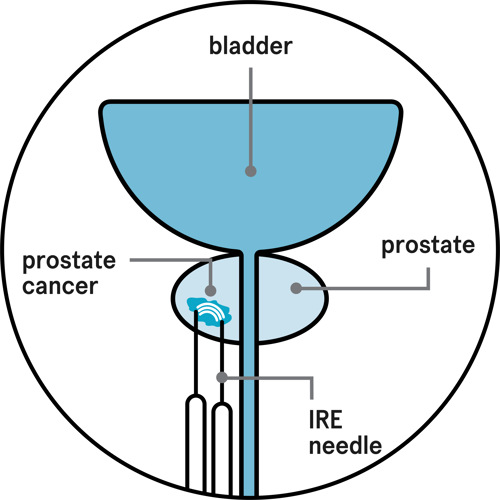
Irreversible electroporation (IRE, also called Nanoknife™) uses short pulses of electricity to damage and kill prostate cancer cells. During the treatment, special needles are put into the prostate and the electrical current is passed through them to treat the cancer cells.
It is newer than other treatments, so we still need to know more about how well it works in the long term. You can only have IRE at a specialist centre, so not all hospitals offer it as a treatment. Some private clinics do it too, but you would have to pay for it yourself or through your health insurance if you have one.
Who can have IRE?
IRE is usually only offered to some men whose cancer is still inside the prostate (localised prostate cancer).
It is not suitable for men with locally advanced prostate cancer or advanced prostate cancer.
IRE is also not suitable for men with electronic implants, such as pacemakers, as the electrical current may stop the them working correctly.
Other treatment options
The stage and grade of your prostate cancer help your doctor to decide which treatment you may need. Read more about the treatment options for localised prostate cancer, locally advanced prostate cancer and advanced prostate cancer.
What are the advantages and disadvantages?
Everyone's experience of prostate cancer is different and what may be important for one person may be less important for someone else. If you're offered IRE, speak to your doctor or nurse before deciding whether to have it. They can help you decide if it's right for you.
Take time to think about whether you want to have IRE. We've included a list of questions that you might find helpful. You can also ask about any other treatments that might be available.
Advantages
It is less invasive than surgery because it only uses needles and no cuts are made to your body.
It can treat small areas of cancer while causing little damage to nearby tissue, nerves and muscles.
You only need a short hospital stay – you can usually go home on the same day as your treatment.
Recovery is usually quick and most men get back to their normal, gentle daily activities within one or two weeks.
It is less likely than surgery and radiotherapy to cause erection or urinary problems.
You may be able to have IRE again if your cancer comes back after your first IRE treatment. This isn’t the case with all treatments.
You may also be able to have other treatments after IRE if your cancer comes back, such as surgery or radiotherapy.
Disadvantages
At the moment, IRE isn’t widely available in the UK and you may need to travel a long way to your nearest treatment centre.
You might get side effects, such as urinary and erection problems.
IRE can affect your ability to have children (fertility). If you want to have children, speak to your doctor about storing your sperm in a sperm bank before having the treatment.
Compared with other treatments, we don’t know as much about how well IRE works to control prostate cancer in the long term (over 10 years). You can ask your consultant to show you results of IRE treatments they have given.
Because it doesn’t treat the whole prostate, IRE might miss some of the cancer cells, which means you may need further treatment.
What does it involve?
Each hospital does things slightly differently. We’ve included some general information. Your doctor or nurse will give you more information about what will happen before, during and after your treatment.
Before treatment
Your bowels need to be empty during IRE so that your doctor can get clear images of your prostate. Before the treatment, you might be given an enema to empty your bowels. An enema is a liquid medicine put inside your back passage (rectum).
Your nurse will put a thin tube called a catheter up your urethra (the tube you urinate through). If you can’t have a catheter in your urethra, you may have one through a small cut in your lower tummy (a suprapubic catheter), but this is not very common. The catheter drains urine out of your bladder and into a bag.
During treatment
A urological surgeon will carry out the IRE. You may also hear them called a urologist or consultant urologist. IRE is done under general anaesthetic. This means you will be asleep and won’t feel anything during treatment. You will also be given a drug called a neuromuscular blocking agent to stop your muscles twitching (muscle spasms) during your treatment.
The surgeon then places a transrectal ultrasound (TRUS) probe inside your back passage, so that an image of your prostate can be seen on a screen. This is called TRUS guidance. It will show your surgeon where to put the needles so they can treat the prostate cancer cells and avoid damaging healthy tissue near the cancer cells.
Between three and six thin needles are put into your prostate through the skin between your testicles and back passage (perineum). Short bursts of strong electricity are passed through the needles into the prostate.
The urologist may take the needles out and move them to different parts of your prostate until all the cancer has been treated. IRE should take about one to two hours. Once the treatment is finished, the needles are removed.
After your treatment
You should be able to go home on the same day as your treatment. Your doctor or nurse will check that you’ve recovered from the anaesthetic and are fit to go home. You shouldn’t drive for 24 to 48 hours after the anaesthetic. You could take public transport or ask a family member or friend to take you home.
You may have pain in your penis, back passage or the area between your testicles and back passage. But this usually goes away by the time you leave the hospital and you’ll be given pain-relieving medicine to take at home if you need them.
You will also get antibiotics to prevent infection and may be given a medicine called a laxative to help you empty your bowels.
IRE can cause the prostate to swell to begin with, which can make it difficult to urinate. You’ll have a catheter to drain urine from your bladder until the swelling has gone, usually for up to a week after treatment. You may also be given tablets called alpha blockers (tamsulosin or alfuzosin) to help relax your prostate.
Before you go home your doctor or nurse will show you how to look after your catheter. They’ll also give you an appointment to have your catheter removed.
What happens afterwards?
You will have check-ups either at the hospital or at your GP surgery. This is often called follow-up. The aim is to:
check how your cancer has responded to treatment
deal with any side effects of treatment
give you a chance to raise any concerns or ask any questions.
You will have regular PSA blood tests to check how well the IRE has worked.
Your PSA levels may go up straight after treatment with IRE. This is because the treatment will cause inflammation in your prostate, which can cause an increase in PSA levels. But your PSA levels should go down and stay low after about six months, once your prostate has healed. After a year, a continuous rise in your PSA level could be a sign that your cancer has come back. If this happens, your doctor may suggest you have further tests, such as an MRI scan and a biopsy.
You will have a PSA test every three months for the first year after your treatment, then every six months for the next two years. After that, you will have a PSA test once a year. Before you leave the hospital, check with your doctor or nurse where you will be having your PSA test as these may be done at your GP surgery or at the hospital.
You will also have an MRI (magnetic resonance imaging) scan at the hospital a few weeks after your treatment to check that all the cancer cells in your prostate were treated. After that, you may have an MRI scan one year after your treatment, then three years after and five years after your treatment. If the MRI shows that the cancer might have come back, then you will have a biopsy to find out for sure.
If your cancer comes back, your doctor will talk to you about further treatment options.
Side effects
Like all treatments, IRE can cause side effects. These will affect each person differently, and you may not get all of them.
Your doctor or nurse can talk through the side effects with you. Tell them which side effects you’re most worried about, so they can help you decide if IRE is right for you. The surgeon might also be able to show you the results of past treatments they’ve carried out. You could also ask if it would be possible to speak to someone they’ve already treated.
Most of the side effects are not as severe as the side effects of other treatments, such as surgery and radiotherapy. If you do get side effects, they will usually be short-term. Some men might get long-term side effects, but these are not very common.
Short-term side effects
Blood in your urine, semen or back passage
You might see some blood in your urine while the catheter is in place. You may also see blood in your semen, or a small amount of blood coming out of your back passage. Blood in your urine and back passage should go after a few days. Blood in your semen usually also goes away after a few days, but for some men it can last for a few weeks or months.
You might also see some small pieces of prostate tissue in your urine after IRE. This is normal. If you are worried or see signs of an infection, lots of blood clots in your urine, or bright red blood every time you urinate, then go to A&E straight away.
Bruising, swelling, bleeding and pain
It’s normal to have some bruising and swelling around your testicles and perineum (the area between your testicles and back passage). These can last up to two months and will gradually get better on their own.
There may also be some bleeding where the needles went into the perineum, but this not very common. Your hospital doctor or nurse will tell you how to apply a dressing to that area if you need one.
It’s also normal to feel some pain or discomfort around your back passage, perineum or testicles for up to two months after your treatment. Your hospital team will give you some pain-relieving drugs before you leave the hospital, and you can get some more from your GP if you need it.
Infection
Some men get a urine infection after their treatment. This is usually caused by the catheter. Before you go home, your nurse will show you how to use your catheter and how to look after it to avoid urine infections. Signs of an infection include:
a fever (high temperature)
feeling shivery
a burning feeling when you urinate
dark or cloudy urine with a strong smell
needing to urinate more often than usual.
Tell your doctor or nurse if you have any signs of a urine infection. They’ll usually give you antibiotics to treat the infection.
Read more about tips to prevent urine infections when you have a catheter.
Bladder spasms
Some men with catheters find they suddenly urgently need to empty their bladder before their bladder is full. This is because the catheter can irritate the bladder causing the bladder muscles to twitch and squeeze (spasm) without you controlling it. This will usually stop once your catheter has been removed. Tell your doctor or nurse if you have bladder spasms. They can advise you on how to manage it or give you medicines to prevent it.
Long-term side effects
Urinary problems
Some men may have urinary problems after IRE, but this isn’t common.
You may need to urinate more often than usual after IRE. This is called urinary frequency and usually gets better over time.
You might also leak urine (incontinence). This usually gets better over time, and there are ways of managing incontinence. But if it lasts more than 6 months, there are treatments that can help.
After IRE, the dead prostate cancer tissue will pass out of your body in your urine. This can sometimes block the urethra (the tube you urinate through). If your flow of urine is weak or slow after your catheter is taken out, speak to your doctor or nurse.
Some men find, their urethra may become narrow. This is called a stricture, and is usually caused by the catheter damaging the urethra. This can make it difficult for you to urinate. It usually happens 6 to 12 months after having your catheter removed. Speak to your hospital doctor or nurse if you have trouble urinating – there are treatments that can help.
If you can’t urinate at all, call your doctor or nurse straight away or go to your nearest accident and emergency (A&E) department. They may need to drain your bladder using a catheter.
They might also suggest using a temporary catheter (self-catheterisation). This is where you put a catheter in yourself when you want to urinate and take it out afterwards. Some men find that urinary problems improve over a few weeks, but other men need further treatment to clear the blockage.
Sexual problems
Some men have problems getting or keeping an erection (erectile dysfunction) after IRE, but this is not common. This is because IRE can damage the nerves that control erections. For most men this will improve, but for others this will be a longer-term side effect of IRE. Your risk of erection problems may also depend on how good your erections were before treatment. There are treatments that can help with erection problems.
You should still be able to orgasm (climax), but you might release less semen (the fluid that carries sperm), or no semen at all. Your semen might look more watery than before you had treatment, but this is normal.
IRE can sometimes cause retrograde ejaculation. This is where the semen travels backwards into the bladder when you orgasm, rather than out through your penis. The semen is then passed out of the body when you next urinate. It isn’t harmful and shouldn’t affect your enjoyment of sex, but it may feel different to the orgasms you’re used to.
Changes in your semen mean you may not be able to have children naturally after treatment. If you’re planning to have children, you might be able to store your sperm before IRE to use in fertility treatment. If this is important to you, ask your doctor or nurse about it.
Talk to your doctor or nurse if you have problems with erections or other sexual problems. They can explain your treatment options and arrange free treatment on the NHS. They can also refer you to an erectile dysfunction (ED) clinic.
Our Specialist Nurses also offer a telephone service supporting people with sexual problems after treatment for prostate cancer. They can talk to you about the impact of treatment on your sex life and relationships, and discuss possible treatments or ways to deal with these changes.
Read more about sexual problems and how to manage them.
A hole between your back passage and the urethra (rectal fistula)
Very rarely, IRE can cause a hole between the back passage (rectum) and the urethra. This is called a rectal fistula. Signs of a possible rectal fistula include:
urine coming out of your back passage
pain in your pelvis or back passage
bowel contents in your urine
air bubbles in your urine
urine infections, but these can also be caused by other things.
Talk to your doctor or nurse straightaway if you think you may have a rectal fistula. You may need an operation to repair the hole.
Dealing with prostate cancer
Being diagnosed with prostate cancer can change the way you think and feel about life. It’s normal to feel scared, worried, stressed, helpless or even angry. Lots of men with prostate cancer get these kinds of thoughts and feelings. But there’s no ‘right’ way to feel and everyone reacts in their own way. Our wellbeing hub has information to help support you in looking after your emotional, mental, and physical wellbeing.
Finding out about things you can do to help yourself can help you to feel more in control. Families can also find this a difficult time and they may need support and information too. If you are close to someone with prostate cancer, find out more about how you can support someone with prostate cancer and where to get more information.
Questions to ask your doctor or nurse
Where is this treatment available?
Can I see the results of IRE treatments you have carried out?
What are my other treatment options?
What are the side effects of IRE? How likely am I to get them?
How can I manage any side effects I get?
How will I know if the treatment has worked?
How likely is it that I’ll need more treatment after IRE?
What treatments are available after IRE?
Reviewers and references
Updated: October 2026|To be reviewed: October 2029
Written by the Prostate Cancer UK Health Information team.
We are committed to reviewing this content within the stated time frame to ensure it is based on the latest published research and maintains clinical accuracy. This is in line with our commitment to the PIF TICK.
Mark Emberton, Consultant Urologist, University College Hospitals NHS Foundation Trust
Karen Wilkinson, Uro-Oncology Clinical Nurse Specialist, University College Hospitals NHS Foundation Trust
our volunteers
our Specialist Nurses.
Cheng J, Adhami M, King D, Yaxley J, Kavnoudias H, Grummet J. Focal irreversible electroporation for the treatment of localised prostate cancer: a systematic review. Transl Androl Urol. 2025;14(12):4012–32. doi:10.21037/tau-2025-678
Cribbs KA, Manning EF, Zhou J, Lahue BJ, Polascik TJ. Real-World Comparative Safety and Effectiveness of Irreversible Electroporation and High-Intensity Focused Ultrasound for Prostate Cancer Ablation. Urology. 2023 Apr 1;174:7–17. doi:10.1016/j.urology.2023.01.024
Imperial College Healthcare NHS Trust. Nanoknife focal irreversible electroporation (IRE) for the treatment of the prostate [Internet]. 2024 [cited 2026 Jul 7]. Available from: https://www.imperial.nhs.uk/-/media/website/patient-information-leaflets/urology/nanoknife-focal-irreversible-electroporation-ire-for-the-treatment-of-the-prostate.pdf?rev=c0f067dc22b044b8bc249ffe7fb244dd
National Institute for Health and Care Excellence. Irreversible electroporation for treating prostate cancer HTG688 [Internet]. NICE; 2023 [cited 2026 Sep 29]. Available from: https://www.nice.org.uk/guidance/htg688
National Institute for Health and Care Excellence. Prostate cancer: diagnosis and management. NICE Guideline 131 [Internet]. 2021. Available from: https://www.nice.org.uk/guidance/ng131/resources/prostate-cancer-diagnosis-and-management-pdf-66141714312133
NHS. nhs.uk [Internet]. 2022 [cited 2025 May 28]. Urinary tract infections (UTIs). Available from: https://www.nhs.uk/conditions/urinary-tract-infections-utis/
Ong S, Leonardo M, Chengodu T, Bagguley D, Lawrentschuk N. Irreversible Electroporation for Prostate Cancer. Life. 2021 Jun;11(6):490. doi:10.3390/life11060490
Poitevin M, Ferragu M, Bigot P, Culty T, Venara A. Rectourethral fistulas after treatment for prostate carcinoma: Update and new management algorithm. J Visc Surg. 2025 Jun 1;162(3):199–208. doi:10.1016/j.jviscsurg.2025.01.010
Royal College of Physicians of London, Royal College of Radiologists (Great Britain), Royal College of Obstetricians and Gynaecologists (Great Britain). The effects of cancer treatment on reproductive functions: guidance on management : report of a working party. Royal College of Physicians; 2007.
Shin D, Yoon CE, Kwon HJ, Moon HW, Park YH, Cho HJ, et al. Irreversible electroporation for prostate cancer using PSMA PET-CT. Prostate Int. 2023 Mar 1;11(1):40–5. doi:10.1016/j.prnil.2022.08.004
University College London Hospitals NHS Foundation Trust. University College London Hospitals NHS Foundation Trust [Internet]. 2025 [cited 2026 Jul 7]. NanoknifeTM for prostate cancer. Available from: https://www.uclh.nhs.uk/patients-and-visitors/patient-information-pages/nanoknife-prostate-cancer
Zhang K, Stricker P, Löhr M, Stehling M, Suberville M, Cussenot O, et al. A multi-center international study to evaluate the safety, functional and oncological outcomes of irreversible electroporation for the ablation of prostate cancer. Prostate Cancer Prostatic Dis. 2024 Sep;27(3):525–30. doi:10.1038/s41391-023-00783-y
You may also be interested in...
Localised prostate cancer
Prostate cancer treatments
Dealing with my diagnosis

