
Pelvic floor muscle exercises
What are pelvic floor muscles?
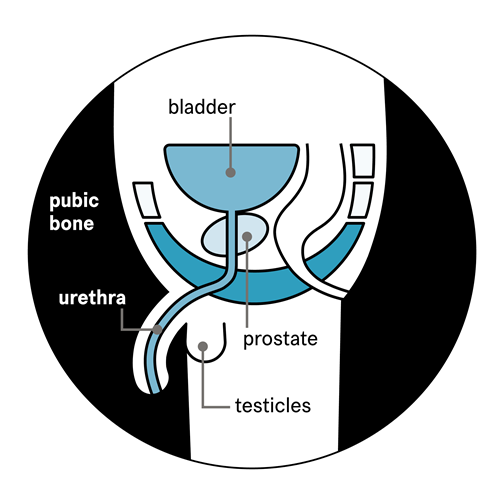
The pelvic floor muscles stretch from the pubic bone at the front of your body, underneath your bladder and bowel, to the bottom of your spine (see diagram below). They act as a sling, supporting the bladder and bowel and helping to control when you urinate (wee) or empty your bowels. They also help with erectile function. Pelvic floor muscle exercises help to strengthen these muscles.
What problems can pelvic floor exercises help with?
Treatments for prostate cancer or other prostate problems, such as surgery (radical prostatectomy), transurethral resection of the prostate (TURP) and radiotherapy, can cause side effects.
Having strong pelvic floor muscles may help improve some of these, including urinary problems, such as:
leaking urine (including stress and urge incontinence)
a sudden urge to urinate (urgency), sometimes leaking before you get to the toilet (urge incontinence)
needing to urinate more often (frequency), including at night (nocturia)
dribbling after urinating (after-dribble)
leaking urine when you get sexually aroused or orgasm (climacturia).
Pelvic floor exercises may also help with:
getting or keeping an erection after prostate cancer treatment
improving erection quality
bowel problems, such as urgency, bowel leakage (faecal incontinence) or passing a lot of wind.
Pelvic floor muscle exercises fact sheet
This fact sheet is for men who want to know more about pelvic floor muscle exercises.
When should I start the exercises?
If you’re having radiotherapy
If you’re having radiotherapy to treat prostate cancer, it’s safe to do pelvic floor exercises during and after your course of treatment.
If you’re going to have surgery
If you’re going to have surgery for prostate cancer or an enlarged prostate, it’s a good idea to start doing the exercises four to six weeks before the surgery. This will help you to do them properly after your treatment. It might also help you to stop leaking urine sooner.
After surgery, you’ll have a catheter to drain urine from your bladder. Do not do pelvic floor muscle exercises while you have a catheter in. You can start doing pelvic floor muscle exercises as soon as your catheter has been removed. They’re safe to do, and won’t hurt or cause any damage. But like all muscles, pelvic floor muscles can become tired so try not to overdo it.
If you’ve had surgery
If you've already had surgery but still have urinary problems, starting the exercises could still help. You should also speak to your doctor or nurse, as there may be other treatments that could help.
How do I find my pelvic floor muscles?
It’s important to find the right muscles before you start doing pelvic floor muscle exercises. You can do this when you’re sitting, standing or lying down – whatever you find most comfortable, as long as you relax your thighs and buttocks.
If you want to do this when you are sitting, sit forward on a chair with your feet on the floor, shoulder width apart.
If you are standing up, stand with your feet shoulder width apart. You may want to try standing with your back against a wall, knees slightly bent. This is a good starting position when finding your pelvic floor muscles.
If you prefer lying down, lie on your back with your knees bent and slightly apart, and your feet apart on the floor.
Finding your pelvic floor muscles
Tighten the ring of muscle around the opening to your back passage (anus) as if you’re trying to control wind. Then relax. Make sure you don’t squeeze your buttocks together, and try not to tighten your thigh muscles or abdominal (stomach) muscles. And try not to hold your breath – just keep breathing normally.
At the same time, imagine you’re urinating and tighten your muscles as if you’re trying to stop mid-flow, then relax. You can try this once or twice while you’re actually urinating if this helps you to find the right muscles – but don’t do this all the time as it could cause problems emptying your bladder.
If you’re tightening the right muscles, you should feel a dip at the base of your penis and feel your scrotum (the skin around the testicles) move up a little. You might find it helpful to do the exercises in front of a mirror to begin with, so you can see the base of your penis and your scrotum move.
You can also check if you’re using the right muscles by touching the skin just behind the scrotum. You should feel the muscles lift up and away from your fingers when you tighten them. If you feel the muscles pushing down, you aren’t doing the exercises properly.
How do I do the exercises?
Make sure you’ve found the right muscles, and you know what it feels like to tighten them, before trying these exercises. There are two sets of exercises – slow and fast. You can practice sitting, standing or lying down – whichever you prefer. But when you feel able and ready you should try to do them standing.
As you become more confident, you can fit them into daily activities, for example while watching TV, waiting at a bus stop or standing in a queue. No one will know you're doing them.
Slow pelvic floor muscle exercises
Slowly tighten the muscles so you feel a lifting sensation.
Try to hold this lift for 10 seconds. Keep breathing normally.
Slowly relax the muscles and rest for 10 seconds.
Aim to repeat the lift and rest up to 10 times.
You might find that you can’t hold the lift for 10 seconds to start with. Just hold it for as long as you can and try to build up to 10 seconds. It’s more important to do the exercises properly than to do them for the full 10 seconds.
Fast pelvic floor muscle exercises
Repeat the same action but this time, try tightening the muscles as quickly as possible.
Hold the lift for one second and then let go.
Try to do up to 10 of these short, fast lifts.
Try to concentrate while you’re doing the exercises. Remember to breathe normally. If you don’t do them properly, they might not help
How often should I do the exercises?
There’s no fixed advice on how often you should do pelvic floor muscle exercises. Speak to your doctor continence advisor, men’s health physiotherapist or nurse to see what they suggest.
You may want to try doing a set of slow and fast exercises three times a day. And try to make them part of your daily routine.
Don’t overdo it. Like any muscle, the pelvic floor can get tired. You might notice that you leak more urine towards the end of the day, as your muscles get tired. This should get better with time as the muscles get stronger.
It might help to tighten your pelvic floor muscles at certain times.
When you leak urine. Tighten the muscles strongly before and during activities that make you leak urine – for example, standing up, lifting, coughing or sneezing. Over time, this might help to prevent urine leaking.
After urinating. Tighten the muscles strongly after you urinate. This should help stop dribbling.
It’s important to be patient and keep doing the exercises. It takes time to see an improvement – it won’t happen overnight.
You might see a small improvement each week, but it can take up to three months before you notice a real difference. The exercises might not work for some men, but there are other things that might help.
You’ll need to keep doing the exercises for the rest of your life, Once your pelvic floor muscles are stronger, you may be able to do fewer exercises, but doing some each day will help keep them strong.
You may want to download the NHS recommended Squeezy App. Squeezy is a self-management app to help people with urinary incontinence do pelvic floor muscle exercises.
Pelvic floor exercises still work for me 10 years after my prostate surgery
What else can help?
If pelvic floor muscle exercises don’t help to improve your urinary problems, there are treatments available and things you can do to help yourself.
If you often need to wee during the night, try to drink less in the two hours before bed.
But drink plenty of fluids during the day (about 3-4 pints a day). If your urine is dark, this could be a sign that you need to drink more.
Avoid fizzy drinks, alcohol and caffeine (tea, coffee and cola), as these can irritate the bladder.
If you get a sudden urge to urinate, try tightening your pelvic floor muscles and holding. Wait calmly until the urge passes, then walk slowly to the toilet. Don’t rush as you walk, as this could make you more likely to leak urine.
A technique called bladder retraining may also help with sudden urges to urinate.
Try to maintain a healthy weight and level of fitness. Being overweight can put pressure on your pelvic floor muscles. This could make you leak more urine. You may find our information on Diet and physical activity helpful.
Some types of exercise such as Pilates and yoga may also help to strengthen the pelvic floor muscles.
Eat plenty of foods that contains fibre and drink plenty of fluids to avoid constipation, as this can put pressure on your pelvic floor muscles.
If you smoke, try to stop as this can cause coughing, which puts pressure on your pelvic floor muscles. The NHS website has more information about stopping smoking.
Speak to your doctor if you have hay fever, asthma or bronchitis. It might help your pelvic floor muscles to reduce sneezing and coughing.
Avoid heavy lifting. If you have to lift something heavy, tighten your pelvic floor muscles at the same time. This can help to prevent leaking urine.
Biofeedback
This is a way of monitoring your pelvic floor muscles while you do the exercises. Your continence advisor or men’s health physiotherapist might suggest biofeedback if you’re struggling to find the right muscles or to do the exercises. But many clinics don’t offer biofeedback.
There are different types of biofeedback. You may have an ultrasound scan of your tummy (abdomen) or on the area between your testicles and back passage (perineum). This will show if you’re doing the exercises correctly.
If you’re offered biofeedback, your continence advisor or men’s health physiotherapist will talk to you about the type of biofeedback you will have and what to expect.
Getting support for urinary problems
Urinary problems can be hard to deal with. It can affect you not only physically but emotionally too. You might feel frustrated, embarrassed or anxious, and this can affect how you go about your daily life. Looking after your emotional wellbeing is important, and there is information and support available. You don’t have to cope on your own.
If you have any worries or questions about urinary problems or pelvic floor exercises, speak to your GP, specialist nurse or continence nurse. You can also speak, in confidence, to our Specialist Nurses, or one of our trained one-to-one peer support volunteers.
Visit our wellbeing hub for information to help support you in looking after your emotional, mental, and physical wellbeing.
References and reviewers
Updated: November 2026 | To be reviewed: November 2029
Aguila-Gimeno O, Jareño-Vicens A, Recasens CT. Pelvic floor rehabilitation before radical prostatectomy: a systematic review. BMC Urol. 2025 Sep 2;25(1):224. doi:10.1186/s12894-025-01932-2
Ali M, Hutchison DD, Ortiz NM, Smith RP, Rapp DE. A narrative review of pelvic floor muscle training in the management of incontinence following prostate treatment. Transl Androl Urol. 2022 Aug;11(8):1200–9. doi:10.21037/tau-22-143 PubMed PMID: 36092846; PubMed Central PMCID: PMC9459549.
Anderson CA, Omar MI, Campbell SE, Hunter KF, Cody JD, Glazener CMA. Conservative management for postprostatectomy urinary incontinence. Cochrane Database Syst Rev. 2015;1:CD001843. doi:10.1002/14651858.CD001843.pub5 PubMed PMID: 25602133.
Brea-Gómez B, Pazo-Palacios R, Pérez-Gisbert L, Valenza MC, Torres-Sánchez I. Pelvic Floor Muscle Training with Preoperative Biofeedback in Patients with Postprostatectomy Incontinence: A Systematic Review and Meta-analysis of Randomised Clinical Trials. Eur Urol Focus. 2025 Sep 1;11(5):767–81. doi:10.1016/j.euf.2025.04.004
Burkhard F, Bosch J, Cruz F, Lemack G, Nambiar A, Thiruchelvam N, et al. EAU Guidelines on Urinary Incontinence in Adults. European Association of Urology; 2020.
Chughtai B, Lee R, Sandhu J, Te A, Kaplan S. Conservative Treatment for Postprostatectomy Incontinence. Rev Urol. 2013;15(2):61.
Cornu JN, Elterman D, Hashim H, Herrmann .R.W, Karavitakis M, Malde S. EAU Guidelines on the Management of Non-neurogenic Male LUTS [Internet]. EAU; 2026 [cited 2026 Aug 11]. Available from: https://uroweb.org/guidelines/management-of-non-neurogenic-male-luts
Dorey G. Pelvic floor exercises after radical prostatectomy. Br J Nurs Mark Allen Publ. 2013;22(9):S4–9.
Goonewardene SS, Gillatt D, Persad R. A systematic review of PFE pre-prostatectomy. J Robot Surg. 2018 Sep;12(3):397–400. doi:10.1007/s11701-018-0803-8
Johnson EV, Kaiser K. Clinical Consultation Guide: Pelvic Floor Prehabilitation. Eur Urol Focus. 2024 Jan;10(1):13–5. doi:10.1016/j.euf.2023.10.007 PubMed PMID: 37872079.
Li D, Xu Y, Nie Q, Li Y, Mao G. Predictors of urinary incontinence between abdominal obesity and non-obese male adults. Postgrad Med. 2017 Sep;129(7):747–55. doi:10.1080/00325481.2017.1357419 PubMed PMID: 28724322.
Milios JE, Ackland TR, Green DJ. Pelvic floor muscle training in radical prostatectomy: a randomized controlled trial of the impacts on pelvic floor muscle function and urinary incontinence. BMC Urol. 2019 Dec;19(1):116. doi:10.1186/s12894-019-0546-5
Mungovan SF, Carlsson SV, Gass GC, Graham PL, Sandhu JS, Akin O, et al. Preoperative exercise interventions to optimize continence outcomes following radical prostatectomy. Nat Rev Urol. 2021 May;18(5):259–81. doi:10.1038/s41585-021-00445-5
National Institute for Health and Care Excellence. Prostate cancer: diagnosis and management [Internet]. NICE; 2021. Available from: https://www.nice.org.uk/guidance/ng131
Newman DK, Guzzo T, Lee D, Jayadevappa R. An evidence-based strategy for the conservative management of the male patient with incontinence: Curr Opin Urol. 2014 Nov;24(6):553–9. doi:10.1097/MOU.0000000000000115
NHS Website. nhs.uk [Internet]. 2022 [cited 2025 Feb 20]. The Eatwell Guide. Available from: https://www.nhs.uk/live-well/eat-well/food-guidelines-and-food-labels/the-eatwell-guide/
NICE. Scenario: Storage symptoms | Management | LUTS in men | CKS | NICE [Internet]. 2025 [cited 2026 Nov 3]. Available from: https://cks.nice.org.uk/topics/luts-in-men/management/storage-symptoms/
Norton C, Cody J. Biofeedback and/or sphincter exercises for the treatment of faecal incontinence in adults (Review). Cochrane Database Syst Rev. 2012;(7). doi:10.1002/14651858
Olagundoye O, Odusanya B, Kung JY, Gibson W, Wagg A. A scoping review of risk factors for urinary incontinence in older men. BMC Geriatr. 2023 Sep 2;23(1):534. doi:10.1186/s12877-023-04249-7 PubMed PMID: 37660036; PubMed Central PMCID: PMC10474661.
Panda S, Mohammed YA, Abdelshafi A, Mohamed H, Deameh MG, Mohamed T, et al. The efficacy and optimal timing of pelvic floor muscle training for post-prostatectomy incontinence in BPH patients: A systematic review. UroPrecision. 2026;4(2):69–77. doi:10.1002/uro2.70048
Rao SS. Current and emerging treatment options for fecal incontinence. J Clin Gastroenterol. 2014;48(9):752.
Siegel AL. Pelvic floor muscle training in males: practical applications. Urology. 2014 Jul;84(1):1–7. doi:10.1016/j.urology.2014.03.016 PubMed PMID: 24821468.
Spratt DE, Pei X, Yamada J, Kollmeier MA, Cox B, Zelefsky MJ. Long-term Survival and Toxicity in Patients Treated With High-Dose Intensity Modulated Radiation Therapy for Localized Prostate Cancer. Int J Radiat Oncol. 2013 Mar;85(3):686–92. doi:10.1016/j.ijrobp.2012.05.023
The British Association of Urological Surgeons (BAUS). Pelvic Floor Exercises in Men [Internet]. 2025. Available from: chrome-extension://efaidnbmnnnibpcajpcglclefindmkaj/https://www.baus.org.uk/_userfiles/pages/files/Patients/Leaflets/Pelvic%20floor%20XS%20male.pdf
Ussing A, Dahn I, Due U, Sørensen M, Petersen J, Bandholm T. Efficacy of Supervised Pelvic Floor Muscle Training and Biofeedback vs Attention-Control Treatment in Adults With Fecal Incontinence. Clin Gastroenterol Hepatol. 2019 Oct 1;17(11):2253-2261.e4. doi:10.1016/j.cgh.2018.12.015 PubMed PMID: 30580089.
Zhang Y, Hou S, Qi Z, Wu S, Zhu K, Wang W. Non-pharmacological and nonsurgical interventions in male urinary incontinence: A scoping review. J Clin Nurs. 2023;32(17–18):6196–211. doi:10.1111/jocn.16749
Roshna Bhulia, Consultant Urology Radiographer, North Middlesex University Hospital
our Specialist Nurses
our Volunteers.
