
Featured Research Project

Understanding why prostate cancer treatments stop being effective
Current treatments including chemotherapy, radiotherapy, and hormone therapy can help manage advanced prostate cancer. However, although many men respond well initially, treatment resistance can develop over time.
A world-leading research team at The Institute of Cancer Research, led by Professor Johann de Bono, Dr Adam Sharp and Dr Alec Paschalis, is investigating the biological mechanisms that drive treatment resistance and exploring potential approaches to reverse it.
Recent work by the team demonstrated that myeloid cell infiltration in prostate cancer tumours drives tumour growth and contributes to the development of hormone therapy resistance. In a proof-of-concept trial involving 21 men with advanced prostate cancer, they tested whether combining AZD5069 - an inhibitor of the CXCR2 receptor on myeloid cells that mediates chemotaxis - with enzalutamide could reduce myeloid cell infiltration and overcome hormone therapy resistance. The results were highly encouraging, with five men responding to the combination therapy. Some men’s tumours shrank by more than 30 per cent, while others had marked reductions in PSA levels or in circulating tumour cells.
With funding from our Transformational Impact Awards, the team will build on these findings in a Phase II clinical trial. In this study, men will receive SX-682, a drug that blocks CXCR2 as well as the closely related receptor CXCR1, which also mediates myeloid cell chemotaxis. By targeting both receptors, the researchers hope to enhance the clearance of myeloid cells to improve treatment efficacy and outcomes in men.
If successful, this drug could mean treatments like enzalutamide and apalutamide can continue working for even longer, giving men with advanced prostate cancer a totally new way of controlling their disease. This kind of breakthrough could make a real difference for men like Danny.
We believe this could pave the way towards preventing treatment resistance, giving men with advanced prostate cancer who haven't previously responded to therapies a totally new way of controlling their disease - and extending and improving their lives.
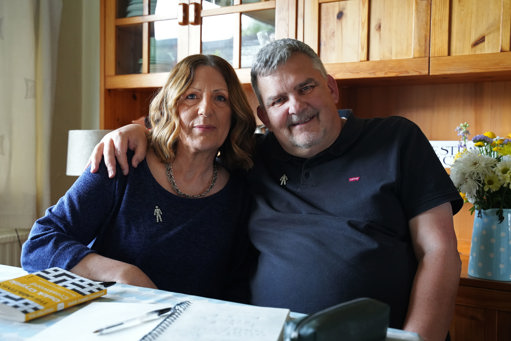
Danny was diagnosed with advanced prostate cancer in June 2021 after experiencing urinary problems. He started taking enzalutamide in November 2023, but his PSA levels started rising and in March of this year he was told that it was no longer working for him.
Not being on enzalutamide has left him feeling vulnerable and unprotected against his cancer. Despite some of the side effects it caused, he’d still rather be taking it.
Danny’s journey has been difficult – mentally and physically – with treatments leaving him feeling tired and experiencing low moods. But with the support of his wife and children, and his church’s active table tennis group, he’s been able to stay positive.
We are hugely grateful to Danny for sharing his story. His journey powerfully emphasises why the research we fund – such as Professor de Bono’s – is so important.
How would this research have helped me? It's a really simple answer. It might have extended my life. But beyond that, it could make this new drug available for more men like me in the future, who have this spectre of symptoms and side effects and, ultimately, time hanging over them.
Raising further funds to support vital research
We shared the exciting research of Professor Johann de Bono and team, along with Danny's story, in a fundraising appeal to our supporters.
This appeal has already inspired supporters to donate an incredible £210,467.88 to support our work.
The team also presented their work in a fantastic webinar for our supporters. If you would like to watch the webinar, a link to the recording can be found below.
Thank you!
A huge thank you to Dr Adam Sharp, Professor Johann de Bono, Dr Alec Paschalis and Danny Burkey for their hard work and support throughout the process.
